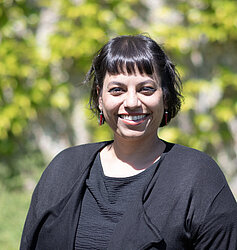
Rebekka KANESU, M.A.
Lecturer and Postdoctoral Researcher
Tel.: +49 931 31-86817
E-Mail: rebekka.kanesu@uni-wuerzburg.de
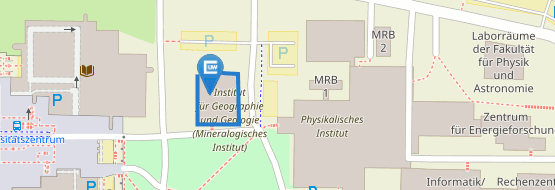
Institute of Geography and Geology
Am Hubland
97074 Wuerzburg
Campus Hubland South
Geography Building
Room 128
About me
I am a postdoctoral researcher and lecturer in economic geography. I am currently working on my new research project, “Product Ambassadors Between Tradition and Transformation: A Feminist Economic Geography Analysis,” in which I examine how the perceptions, roles, and significance of product ambassadors in the marketing of agricultural products are changing. To this end, I integrate feminist economic geography approaches, cultural political economy, and critical perspectives on regional and rural geographies.
In my doctoral dissertation, I examined the political ecologies of water in the context of the Anthropocene, using the Moselle River as a case study. This work led to the book “Flüsse im Anthropozän: Diffraktive Politische Ökologien der Mosel” (2026). A key focus is the analysis of the border river from more-than-human perspectives using diffractive methodology and neo-materialist theory.
My disciplinary background is in social and cultural anthropology (MA) and human geography (Ph.D.). I work primarily within the ethnographic tradition and experiment with (post-)qualitative methodologies.
Appointments for office hours during the lecture-free period are available by arrangement.
Appointments for office hours in the summer semester 2025 are possible in person or via Zoom: Wednesday from 11 am to 12 pm. Please register in advance by email.
- Europe's Border Geographies (Seminar)
- Human Geographies of Water (Seminar)
- Feminist Geographies (Seminar)
- Geographies of Waste (Project Seminar)
I currently have capacity to supervise bachelor's theses. Please contact me by email if you would like to write your thesis under my supervision. Feel free to share your ideas.
In addition to your own topic proposals, you may choose from the following subject areas:
- Feminist (economic) geographies
- Challenges and conflicts in agriculture
- Regional and product marketing in transition
- Human geographical perspectives on water and hydro-social relationships
- Material, spatial, and political conflicts over infrastructure
- More-than-human/posthuman geographies
- Human-environment relationships in the Anthropocene
Economic geography
- Feminist economic geography
- Symbolic economies
- Regional development, regional and product marketing
Human-environment relations
- more-than-human geographies in the Anthropocene
- Political ecologies of water
Political and cultural geography
- Border geographies
Methodology and theory
- (Post)qualitative and diffractive methodologies
- Agential realism, assemblage theory, new materialism, bordertextures, feminist theory
Since 04/2025
Researcher at the Chair of Economic Geography
01/2018 - 12/2024
Research assistant and doctoral candidate at the Governance and Sustainability Lab (Human Geography) at the University of Trier
Topic: Diffracting Mo\u/sel\le/: Political river ecology in the patchy Anthropocene
01/2018 - 12/2020 and 03/2022 - 03/2023
Project officer in the Interreg project “UniGR-Center for Border Studies” at the University of Trier
10/2014 - 04/2017
MA studies in Social and Cultural Anthropology at Ludwig-Maximilians-University Munich
09/2011 - 04/2012
Stay abroad at the Université des Antilles (Guadeloupe); study of francophone Caribbean literature
10/2009 - 04/2014
BA Social and Cultural Anthropology /Romance Studies-French at the University of Cologne
KANESU, R., LAMB, V., & E. MCGRATH (2025): Editorial: Rivers as Borders? Navigating in-between the tensions of water-state-society geographies. Area e70001. DOI: https://doi.org/10.1111/area.70001. Open Access.
KANESU, R. (2024): Liquid Lines: Exploring the Moselle River between France, Luxembourg and Germany. Area, 1-9. DOI: https://doi.org/10.1111/area.12935.
ALBA, R. & R. KANESU (2024): Working with water: a dialogue on care, infrastructure and labour. Territory, Politics, Governance, 1–17. DOI: https://doi.org/10.1080/21622671.2024.2313584. Open Access.
FELLNER, A. M. & R. KANESU (2022): Border as Method. UniGR-CBS Border Glossary. Open Access. (PDF)
FELLNER, A. M. & R. KANESU (2022): Border Thinking. UniGR-CBS Border Glossary. Open Access. (PDF)
KANESU, R. (2022): Rezension: Kulturökologie und ökologische Kulturen in der Großregion/Écologie culturelle et cultures écologiques dans la Grande Région [Review: Cultural Ecology and Ecological Cultures in the Greater Region / Écologie culturelle et cultures écologiques dans la Grande Région]. Kulturwissenschaftliche Zeitschrift 2021(2), 78–83. DOI: https://doi.org/10.2478/kwg-2021-0006. Open Access.
BRUNS, A. & R. KANESU (Hg.) (2020): B/ordering the Anthropocene: Inter- and Transdisciplinary Perspectives on Nature-Culture Relations. Borders in Perspective - UniGR-CBS thematic 5, 24-39. DOI: https://doi.org/10.25353/ubtr-xxxx-2ef3-07f3. Open Access.
KANESU, R. & A. BRUNS (2020): Durchlässige Grenzen im Anthropozän: über multiple Grenzverschiebungen und Wasser als räumliches, zeitliches und ontologisches Grenzobjekt [Permeable Boundaries in the Anthropocene: On Multiple Boundary Shifts and Water as a Spatial, Temporal, and Ontological Boundary Object.]. In: BRUNS, A. & R. KANESU (Hg.): B/ordering the Anthropocene: Inter- and Transdisciplinary Perspectives on Nature-Culture Relations. Borders in Perspective - UniGR-CBS, thematic issue 5, 24-39. DOI: https://doi.org/10.25353/ubtr-xxxx-2ef3-07f3. Open Access.
WILLE, Christian & R. KANESU (Hg.) (2020): Bordering in Pandemic Times: Insights into the Covid-19 Lockdown. Borders in Perspective, thematic issue 4. DOI: https://doi.org/10.25353/ubtr-xxxx-b825-a20b. Open Access.