A geographical view of the wine
05/12/2026Geographical changes and their consequences for viticulture were the focus of an event at the University of Würzburg attended by more than 100 visitors.
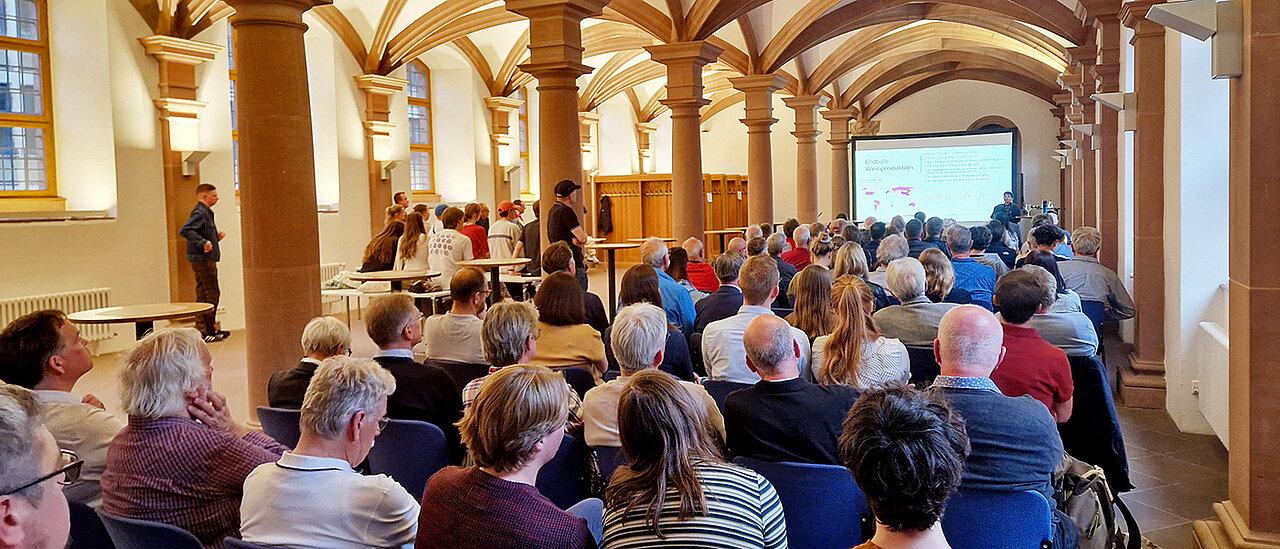
How are geographical and climatic changes already affecting viticulture in Franconia today? What developments can be expected for the Franconian wine region and beyond in the future? These questions were the focus of the evening event "The Geography of Wine" at the beginning of May 2026 with around 100 participants in the foyer of the Neubaukirche.
The climatology, human geography and economic geography working groups at Julius-Maximilians-Universität Würzburg (JMU) organised the event together with the Geographical Society of Würzburg.
Wine is a special crop
Background: Wine characterises regions and local identities like hardly any other crop. As a luxury food that is thousands of years old, wine is not only relevant from a culinary point of view, but also characterises geographies. Wine is geography - the respective local terroir, relief and climate are responsible for making wines so diverse and distinctive.
However, current geographical changes pose new challenges for viticulture, because geography makes wine. For example, climate change means that certain grape varieties can no longer be cultivated or can be cultivated again and cultivation and production techniques have to be adapted to the change. And new distribution and communication channels are opening up global prospects for local wine.
It is therefore clear that there is no "one geography of wine". Rather, "the subject of geography can capture the development, state and current challenges of viticulture in its many dimensions from multiple perspectives," as Professor Marit Rosol emphasised in her introduction to the event. Rosol heads the Chair of Economic Geography at JMU.
As a discipline with both natural science and social science foundations, geography examines geomorphological processes that change the landscape, the nature of soils and climatic changes. On the other hand, the human geography perspective looks at questions of regional identities, the transformation of rural areas and the effects of global economic developments. Physical space, environmental change and social developments thus characterise the geography of wine just as much as global dynamics and local practices.
Viticulture in Franconia: centuries-old tradition and current challenges
Heiko Paeth has his eye on the climate. He is Professor of Climatology at JMU; his research shows that climate change is already making itself felt in Franconia through rising temperatures, heat stress, longer dry periods and heavy rainfall events. His climate models show that this development will intensify in the future - with drastic effects on viticulture in Franconia.
"A survey of winegrowers has shown that many businesses are clearly feeling the effects of climate change, for example through increased sunburn on the vines, higher alcohol content in the wines and earlier ripening and harvesting," reported Paeth. Therefore, measures to adapt to climate change must be taken now.
More greenery in the vineyards, more irrigation and a change in the grape varieties cultivated are the most frequently mentioned adaptation measures, as Paeth's research results show. According to the climate researcher, future climatic developments are expected to lead to new vineyard sites and new cellar and cultivation techniques as further adaptations.
Social media and marketing abroad are gaining in importance
However, it is not only winegrowing that is changing, but also the demand for wine. In her presentation, Dr Rebekka Kanesu, research assistant at the Chair of Economic Geography, addressed the declining consumption of alcohol, especially among younger people, as an additional challenge for viticulture. According to her, changing gender relations and digital change are also shaping the perception and marketing of wine.
In her research, Rebekka Kanesu is investigating the changing role of wine princesses in wine marketing. "As local wine princesses, regional wine queens or German wine queens, the honorary sovereigns have the task of marketing wines and their regions of origin," explained Kanesu. Her research shows that marketing abroad and the use of social media are becoming increasingly important. "Communication about wine as a product is changing, with local products potentially gaining international reach, new target groups being addressed and new networks being formed," said the researcher.
Dr Markus Frankl presented the audience with a brief outline of 1,200 years of viticulture in Franconia. In his historical introduction, the head of the Juliusspital wine shop and first chairman of the "Wine Experience Franconia" association explained how the techniques and forms of cultivation, the quantity and quality of the wine consumed and its marketing have changed again and again over the course of history.
Lively discussion awakens the desire for a continuation
The ensuing discussion centred on issues such as wine as an object of speculation, the cultural attribution of wine and possible future scenarios for Franconian viticulture. The amendment of German wine law and the increasing importance of non-alcoholic wines were also discussed.
Professor Matthias Naumann, who hosted the event and holds the Chair of Human Geography at JMU, promised that the discussion of these issues would be continued as soon as possible in a follow-up event.
Further information on previous research results and ongoing research projects can be found on the websites of the working groups Climatology and Economic Geography.
Contact
Prof. Dr Matthias Naumann, Chair of Human Geography, T +49 931 31-83237, matthias.naumann@uni-wuerzburg.de