Würzburg Remote Sensing celebrates two anniversaries
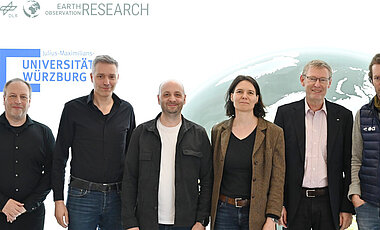
08/04/2026Data from above: the Chair of Remote Sensing at the University of Würzburg has celebrated its 25th anniversary, whilst the EAGLE Master’s programme has marked its tenth. Three generations share their experiences.
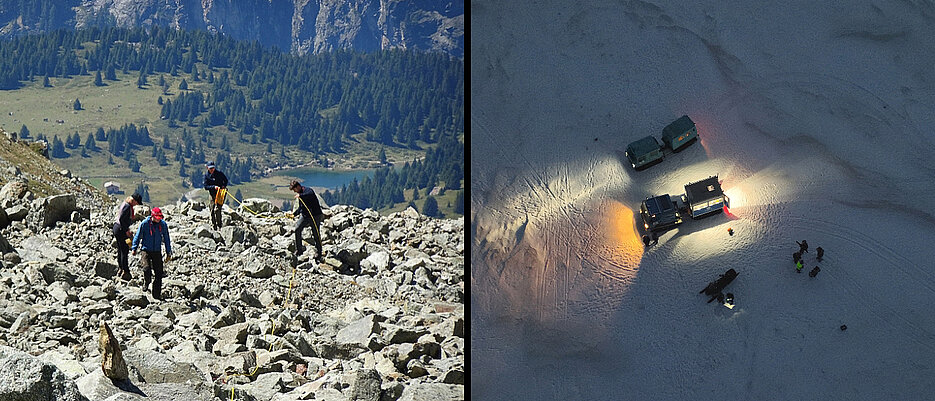
Snow and ice in the Arctic, fires in the savannahs, cities seen from space, the effects of climate change in Bavaria: researchers in remote sensing – also known as Earth observation – collect data from all kinds of ecosystems, from forests and cities right up to high mountain ranges across various continents. They take a bird’s-eye view: they use satellite imagery or drone footage to draw conclusions about urban development, environmental changes and climate change over extended periods of time.
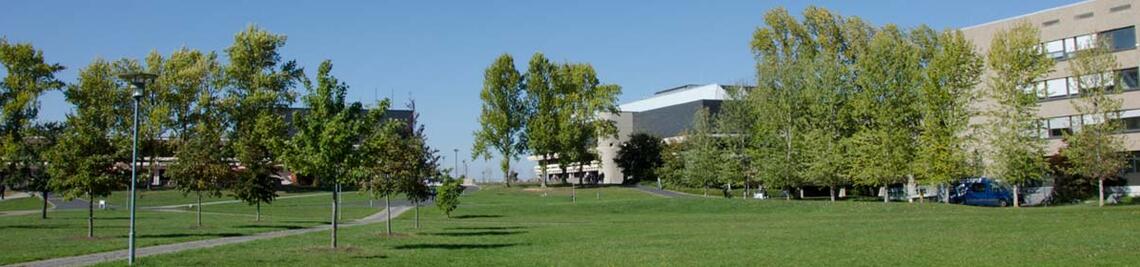
This is how the work of the Chair of Remote Sensing at the Julius-Maximilians-Universität Würzburg (JMU) can be described. Founded in 2001 by Professor Stefan Dech, the Chair is now celebrating its 25th anniversary. But that’s not all: the associated EAGLE (Applied Earth Observation and Geoanalysis) Master’s programme has now reached its tenth anniversary.
In 2022, the Chair joined forces within the Earth Observation Research Cluster (EORC) with Professor Hannes Taubenböck’s then newly established Chair of Global Urbanisation and Remote Sensing. The two chairs collaborate with the German Remote Sensing Data Centre (DFD), an Institute of the German Aerospace Centre (DLR).
From drone operations to artificial intelligence
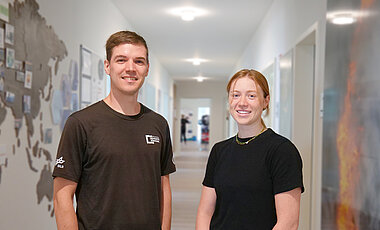
Initially, Stefan Dech employed one research assistant. “Today, there are just under 40 researchers. In addition, we currently supervise around 80 Master’s students and various PhD students,” says Dr Martin Wegmann, research assistant at the Chair of Remote Sensing and responsible for cluster management within the EORC. He has been working there since he began his PhD in 2005 and played a key role in setting up the EAGLE programme ten years later.
Earth observation essentially means researching environmental conditions and changes on Earth – in other words, collecting, processing and analysing data on the nature of the Earth’s surface. Satellite images and aerial photographs have always been, and remain, important sources of data.
“In 2018, we began testing the potential of drones for research, alongside space-based satellites. Initially, we were still using small quadcopters that can be purchased by private individuals,” says Wegmann. That period could still be described as unstructured and chaotic, says the JMU researcher, “the Wild West, so to speak.” Since then, a group of researchers at the EORC has further developed this area of research and turned it into a structured, targeted field of research.
For the past five years, there has been a permanent team at the chair specialising in drone-based Earth observation research and utilising several systems. “We take a structured approach to the work, develop research questions, oversee implementation and work on refining technical workflows,” says Wegmann, “and we are now right at the forefront of drone-based Earth observation across Germany.”
Artificial intelligence (AI) plays an important role in the research: “Deep learning has opened up a whole new world in our field over the last ten years. It provides significant support for image and data analysis,” says Dr Jakob Schwalb-Willmann. The research fellow’s doctoral thesis, due to be completed in 2025, is based on the development of various AI models. These predict environmental conditions using animals’ movement profiles. “The AI recognises patterns in the movement profiles, links these to environmental data collected via remote sensing, and uncovers correlations between animal behaviour and the environment. Normally, most animal species always use the same environmental conditions for specific behaviours, such as wet meadows for feeding,” explains Schwalb-Willmann.
However, anomalies in animal-environment interactions can be detected by AI and provide indications of disruptive events such as forest fires. Such applications could be used in early-warning systems in the future, enabling a faster response to threats to people and nature.
The future of Earth observation
What will the future of Earth observation look like? Martin Wegmann is certain that the field will become significantly more important. “Remote sensing will become increasingly important, particularly in the areas of geohazards and environmental change – for example, in the case of forest fires, such as those currently affecting Spain and France, urban heatwaves, or flooding such as that which occurred in the Ahr Valley five years ago.” The EORC has secured funding for a major new research project (EO4Cam) in this area, which focuses on the impacts of climate change and adaptation in Bavaria.
Jakob Schwalb-Willmann believes that, above all, data synthesis should be expanded. “I see great potential here in bringing together data from different sources and contexts to broaden our view of the Earth’s surface.” One example of this is the EORC’s ecological research in the High Arctic, in which he is involved: “We are investigating how snow conditions, vegetation dynamics and animal behaviour are interrelated and how they are changing in the context of climate change.” To this end, the researchers combine plant and snow data collected on the ground with laser and multispectral data recorded by drones and satellites, as well as reindeer movement data.
At the computer and in the ice desert
Schwalb-Willmann is part of the first cohort of the EAGLE Master’s programme. After studying geography and sociology in Munich, he moved to Würzburg. “I was looking for a Master’s programme that didn’t just teach how to extract information from data. It was also important to me that the programme focused on potential practical applications.” The JMU EAGLE Master’s programme offered both. The early-career researcher has been working at the department since the end of 2018 and is involved in teaching on the EAGLE programme.
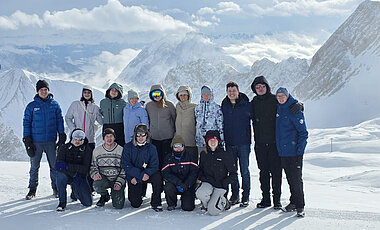
Aoibhin Murphy is a Master’s student in what is now the tenth cohort. The Irish student completed her Bachelor’s degree in Geography in Dublin. She then moved to Würzburg. The practical application aspect was also a factor in her decision to study at JMU. As a student assistant at the EORC, she was already able to experience this first-hand through fieldwork: in early 2026, Murphy spent two months in the High Arctic on the Norwegian island of Spitsbergen as part of an internship.
There, as part of a team, she researched the environmental conditions affecting local reindeer populations in valleys near the town of Svalbard. In the freezing cold, equipped with satellite phones for emergencies and a drone, and travelling by snowmobile, the researchers investigated the size of the herds and how varying snow depths affect their foraging behaviour. “If the risk was too high due to avalanche hazards, polar bears or strong winds, we would sometimes stay at the research station,” says Murphy. A safety team checked daily to see if such conditions were present.
Despite such precautions, there is still a residual risk: “On one occasion, a colleague pointed out to me that the tip of my nose was showing first signs of frostbite. For me, that meant immediately seeking shelter in one of our emergency tents and making sure the skin surface warmed up again,” says Murphy.
Back in the warmth of Würzburg, she is currently working on using an algorithm to upscaling satellite images to a higher resolution. “It’s precisely this mix of fieldwork and theory that makes the Master’s programme so exciting,” sums up the student.
Contact
Dr Martin Wegmann, Chair of Remote Sensing, T +49 931 31-83446, martin.wegmann@uni-wuerzburg.de
Dr Jakob Schwab-Willmann, Chair of Remote Sensing, T +49 931 31-88115, jakob.schwalb-willmann@uni-wuerzburg.de
Additional images