Würzburg’s Water in Focus: Students Present Five Perspectives
07/15/2026Five geography students present the many facets of water in Würzburg in a poster exhibition, covering topics ranging from floods and microplastics to water treatment, availability and supply. The exhibition can be visited until October 2026 in the Geography and Geology Building at the Hubland Süd Campus.
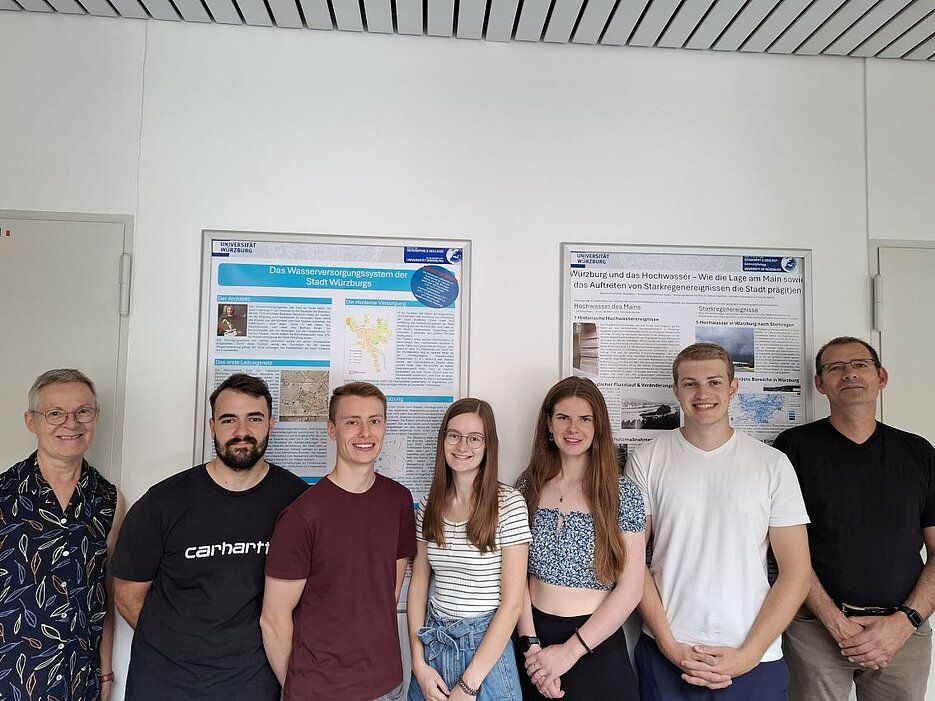
How is Würzburg supplied with drinking water? What effects will climate change have on local water availability? How does the city protect itself against flooding and heavy rainfall, and how does microplastic enter the environment? Five geography students explored these and other questions in detail during the past semester. Their findings are presented in a poster exhibition that can be visited at the Hubland Süd Campus until October 2026.
The posters were created as part of the subject-specific research project “Würzburg’s Water”, supervised by Professor Barbara Sponholz. The aim of the project was to investigate different aspects of water in Würzburg and to present the findings in a scientifically sound, accessible and visually engaging way. The studies combine scientific principles with current societal and urban-planning challenges.
One poster focuses on flooding and heavy rainfall. It traces major historical flood events along the River Main, explains changes to the river’s original course and presents the city’s flood-protection measures. At the same time, it shows that heavy rainfall can cause considerable damage independently of the water level of the Main. Particularly vulnerable areas, the potential effects of climate change and measures for water-sensitive urban development are also discussed.
The poster “Microplastics in Würzburg: Sources, Sinks and Transport Pathways” illustrates how plastic particles may be released and transported within the urban area. Potential sources include road traffic, private households, commercial activities, viticulture and wastewater. Green spaces, the sewer system, the wastewater treatment plant and the River Main may act both as transport pathways and as temporary sinks. The poster also provides insights into the analysis of environmental samples using NMR spectroscopy.
The poster on water treatment in Würzburg addresses the technical side of the urban water cycle. Using the Bahnhofstraße waterworks as an example, it explains how groundwater is treated to produce drinking water through ultrafiltration, activated-carbon filtration and UV disinfection. It also presents the mechanical, biological and chemical treatment stages used at Würzburg’s wastewater treatment plant. The treatment and energetic utilisation of the resulting sewage sludge are also considered.
Another poster examines water availability in Würzburg. Geology, relief, soils and climate together determine how much water is stored, infiltrates into the ground or flows across the surface. While Buntsandstein sandstone can provide favourable groundwater reservoirs, the widespread Muschelkalk limestone areas often have only limited storage capacity. Rising temperatures, increasing evaporation and longer dry periods may place additional pressure on the region’s water resources in the future.
The fifth poster traces the development of Würzburg’s water-supply system. It covers the period from the historical plans of Balthasar Neumann and the expansion of the water-distribution network to the modern supply system based on wells, elevated reservoirs, springs and externally supplied water. It also explains the importance of water-protection zones, efficient infrastructure and forward-looking planning in view of increasing competition for water and changing climatic conditions.
The exhibition highlights the diversity of water-related issues at the local level. Historical developments, natural environmental conditions, technical infrastructure and current environmental problems are closely interconnected. The posters invite visitors to discover Würzburg from a new perspective and to reflect on how water resources should be managed in the future.
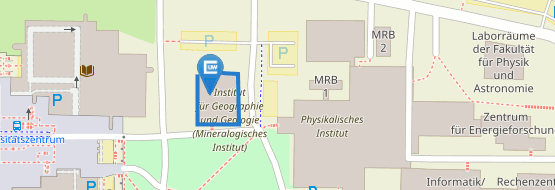
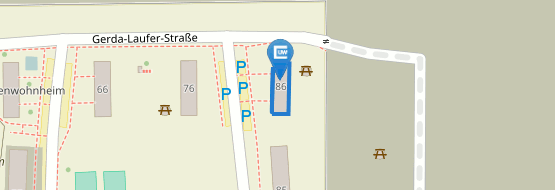
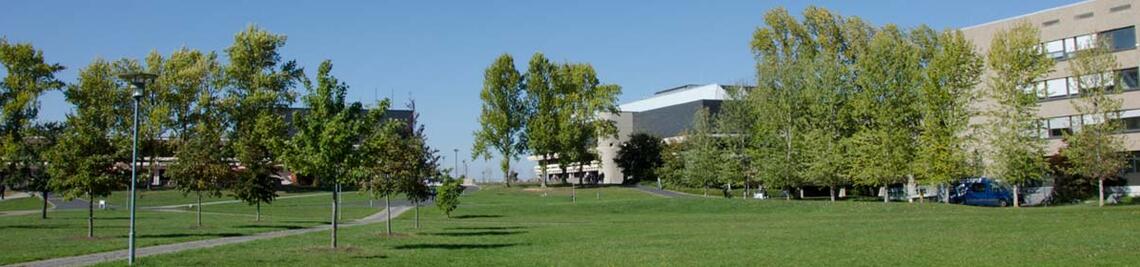
The exhibition can be visited until October 2026 in the Geography and Geology Building (G1) at the Hubland Süd Campus. The posters are displayed in the second-floor corridor near the Chair of Geomorphology.